


Give a gift to the Journalism Collaborative to keep our community informed!
By Chidalu Nnorukah, Matthew Studier, Sasha Wilson & Tabassum Sayeka Tarannum
This story was produced by a collaborative team of students from the Community-Engaged Digital Storytelling (CEDST) Lab at Western Michigan University. It is a joint project with the Southwest Michigan Journalism Collaborative and its equitable community development reporting project. Still images were captured by local photographer Taylor Scamehorn.
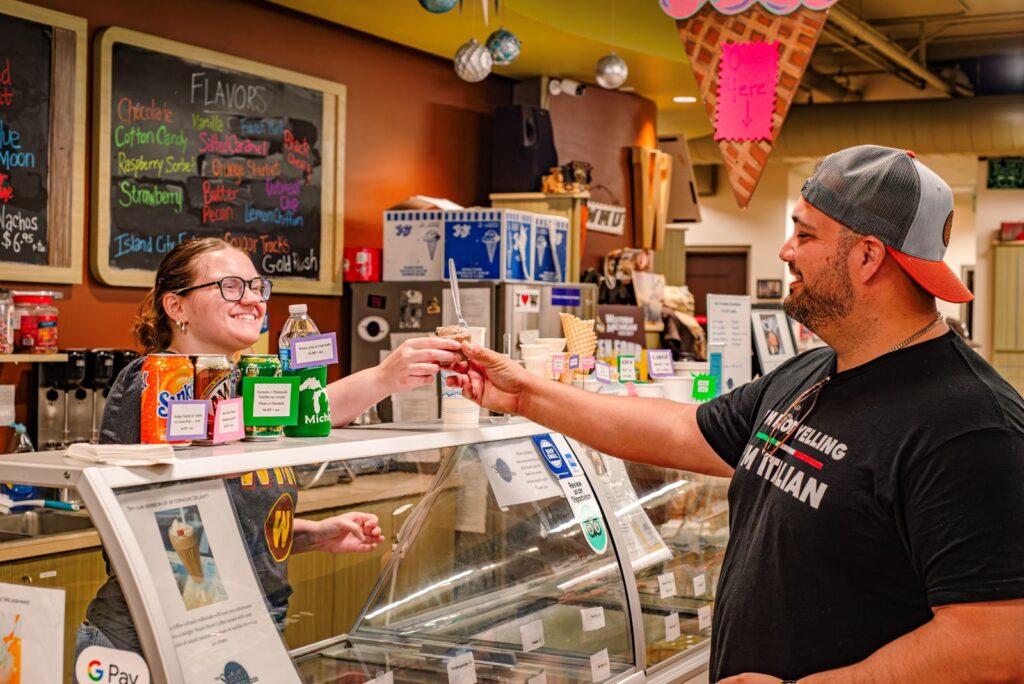
Since opening its doors in 2011, Spirit of Kalamazoo has become a reflection of community pride. Co-owned by Kathleen Widner and her husband, Andrew Widner, the shop serves the customers with a range of locally inspired products, including printed clothing, ice cream, gifts, and dog treats.
In its early years, the business focused primarily on printed apparel for educational institutions such as Western Michigan University (WMU) and Kalamazoo College. Over time, however, the business began to lean more into celebrating the city itself. Today, many of its products feature proud inscriptions of Kalamazoo and the state of Michigan that resonate with locals and visitors alike.
Local businesses like Spirit of Kalamazoo are the backbone of the community. Beyond providing goods and services, they create spaces that foster connection and a sense of belonging. For Kathleen Widner, being part of the community goes beyond running a shop. Spirit of Kalamazoo is a member of the Downtown Kalamazoo Collective, an association of small business owners working together to strengthen the downtown area, of which Widner serves as a board member.
“We work together to come up with fun events to bring people to downtown and also bring people to our stores. We want to be a fun, safe space, but we also want to encourage people to shop and dine in the businesses downtown,” says Kathleen Widner.
Through the collective, business owners organize social events that bring people downtown, not just to shop but also to connect. These events encourage community bonding and help small businesses thrive by attracting people to the heart of the city.
Widner describes one of the ways the collective has helped small businesses thrive: “There is an event we do in September called ‘Dogs in the Zoo’ that helps our dog businesses, but it helps all of us because it’s fun to see dogs, and I sell dog treats and dog bandanas. Another store might sell leashes.
“When Climb Kalamazoo has camps, people come in after their climb day and have an ice cream to celebrate, and when Gazelle Sports does different runs, a lot of people will come in and get an ice cream. And if there is another event happening downtown, it definitely helps other small businesses like ours.”
The collective also provides support beyond events. Members help each other set up digital platforms, share ideas, and encourage each other in ways to strengthen their businesses. For Widner, that support also comes with a sense of responsibility toward fellow shop owners. “We are also sensitive to what other people are selling,” she explains. “If I know that a store is carrying a line of cookware, I could also sell that, but I am going to be sensitive and not do it because I don’t want to take away from their sales,” she says.
For many young people in Kalamazoo, local businesses also serve as a first step into the workforce. Small shops often provide high school and college students with their first job and a chance to integrate into the community. For Widner, this has become one of the most rewarding parts of running the Spirit of Kalamazoo.
Beyond selling products, the business has helped her build friendships, connect with residents, and support students as they grow. “I have employed many college students from Western Michigan College, Kalamazoo College, and Kalamazoo Valley Community College (KVCC) over the years. A lot of them start with us, maybe in their sophomore year, and stay with us until they graduate,” she says.
Running a small business, however, comes with its challenges. For Widner, one of the biggest challenges is the seasonal nature of business in Michigan, where long and harsh winters can significantly slow operations: “The weather is a huge factor. January and February can be the most brutal months. We have some days when the doors never open.”
But the business often recovers when the weather improves, especially during the summer months when warmer temperatures bring in an influx of visitors. “We try to expand the hours during the good weather times, like in June and July. We stay open until 9 pm and take advantage of the tourists who are visiting. We open more, hoping to make up for losses,” says Widner.
Like many small businesses, Spirit of Kalamazoo is still recovering from the impact of the COVID-19 pandemic. The shift toward remote work and a more digital lifestyle has indirectly affected local businesses that once relied heavily on foot traffic in downtown areas. “When COVID hit in 2020, we closed for three months. When we finally opened, it was not as busy. It was really quiet,” Widner recalls.
Before the pandemic, the shop benefited from the steady flow of professionals working downtown. “2019 was our best year; each year has gotten a little better, but nothing like it used to be before COVID. We used to have a lot of office workers who would stop on their lunch break, but coming back is not as it used to be because so many offices are hybrid, ” she adds.
While Kalamazoo still has a growing number of young adults living in residential apartments, Widner believes many of them rely more on doorstep delivery services, such as DoorDash, which further reduce walk-in traffic for small local businesses.
Beyond downtown workers, WMU and Kalamazoo College play a role in helping small businesses thrive. By bringing new students, staff, and visitors into the community each year, the colleges create a steady flow of people who explore downtown and support local shops.
For businesses like Spirit of Kalamazoo, that connection with the university community has become an important part of staying visible and continuing to grow.